
What is the IDS-20d?
During the winter season a lot of our infrastructure is affected by icing. In the transportation sector icing may not only impair the proper functioning of engines, sensors and signaling systems but may also pose serious hazards through icy runways and ice accretion on airplanes. Power generation by wind turbines solar- and hydroelectric generators may not be reliable under icy conditions and power transmission may be interrupted by heavy ice loads on power lines. Last but not least, ice on a building or other structure, e.g. antenna, may add a lot of weight and increase the surface area exposed to wind.
Reliable ice detection systems can help avoid such risks and can contribute to reduce maintenance and replacement costs. The ice detection sensor IDS-20d, in the shape of a cube or of rods, is used for the reliable and precise measurement of icing in aviation, on wind power generators, high voltage power lines, cable cars, antennas, overhead wires, roads, buildings and other structures where the formation of ice constitutes a risk.
Depending on the application the IDS-20d provides a combination of different sensor versions which can measure ice loads from 0.01 mm to 80 mm. By measuring the complex impedance in the vicinity of the sensor the IDS-20d is able to distinguish between water and ice and capable to record ice accretion rates.
A unique and valuable feature of the IDS-20d is that it additionally considers meteorological data for the purpose of a plausibility check: Parallel to the ice-sensor the IDS-20d measures the air temperature and humidity and thereof calculates the dew and frost points. The sensor system then uses these data for a plausibility check together of the measured ice values. Thus, the reliability of ice-detection is improved.
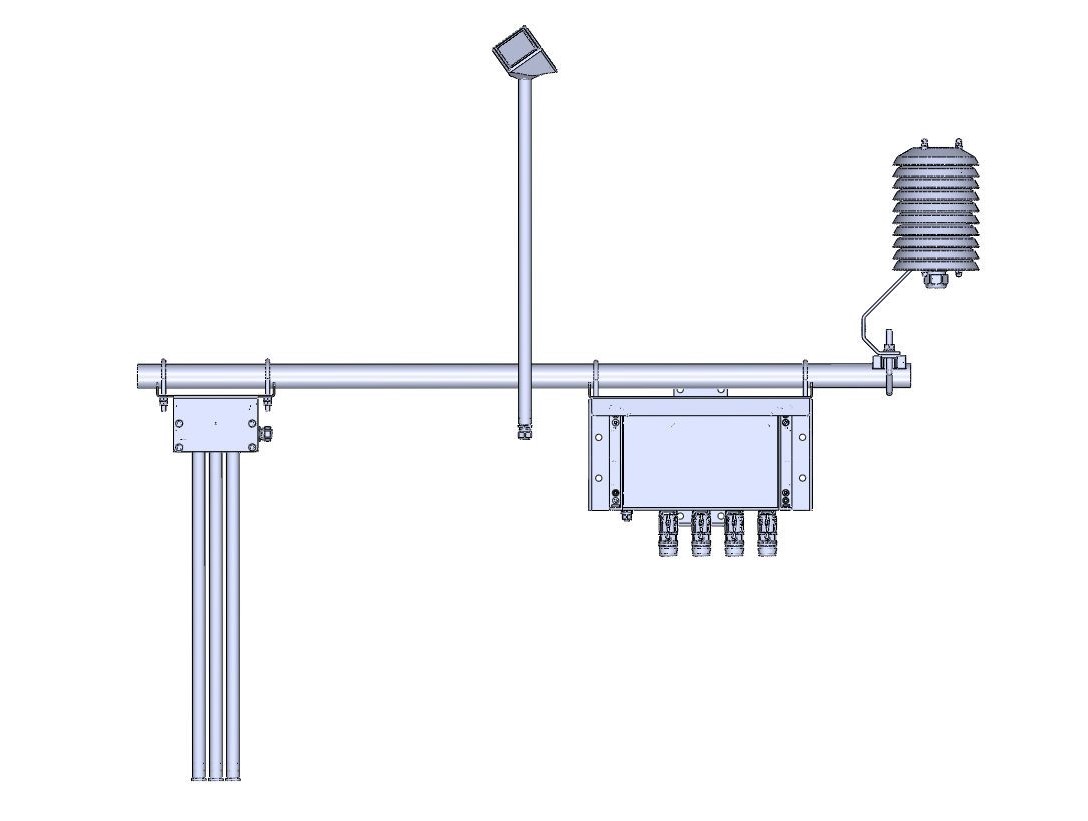
Figure 1 IDS-20d