
Performing a site survey
Every measurement site requires an individual survey to determine the local hydraulic boundary conditions. These conditions are aggregated the a discharge table, which is used to calculate the discharge based on the measured water level and flow velocity.
Follow the instructions below to perform a complete site survey:
-
Select the reference coordinate system
The measurements of the water level, the mounting position of the RQ-30 sensor and points in the cross-sectional profile have to relate to each other. Especially the water levels defined in the discharge table and the water levels measured with the RQ-30 sensor have to be consistent. See Performing a site survey for the available options.
When selecting the reference system for the measurement site, existing installations for water level measurements should be considered.
Sites with an existing water level measurement
If a water level measurement is already present at the measurement site, i.e. gauge plate or gauge sensor, it is recommended to use the gauge zero (GZ) of the existing measurement as the reference level. This level is usually unique and defined permanently. Moreover, consistency in the existing water level measurement and the RQ-30 measurement simplifies interpretation. As illustrated in Figure 10 the level of the gauge zero has to be known in the reference system.
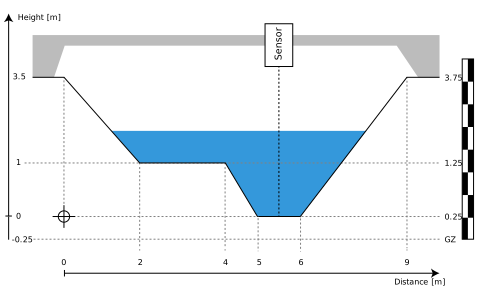
Figure 10 Gauge zero (GZ) of a gauge plate in reference to a channel profile
In the example shown in Figure 10 gauge zero is at -0.25 m in the reference coordinate system of the cross-Section H.
Sites without an existing water level measurement
For measurement sites without an existing water level measurement a new reference has to be defined. It is recommended to select a stable, fixed point as reference for future verification. It is essential to exactly document this point and its relation to the water level W.
For channels with a stable lining a point on the surface can be selected as a reference and gauge zero simultaneously. Thus, the water level can be determined easily and the adjustment procedure for the water level measurement of the RQ-30 sensor is simple.
For all other situations a fixed point has to be selected. Examples are survey points or stable, accessible points on bridges or other structures. This reference point has to be mapped in the coordinates of the cross-Sectional profile. The point does not need to be defined as gauge zero, but needs to relate to it.
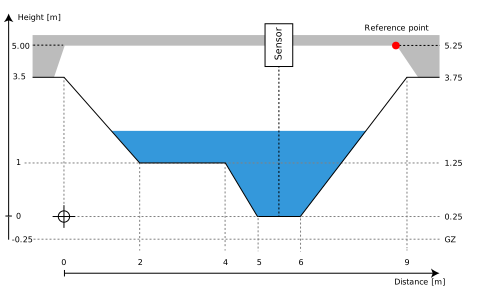
Figure 11 Gauge zero (GZ) with a fixed point referenced to it
In the example of Figure 11 a fixed point was defined on a bridge. The height of the point is 5 m in the reference coordinate system of the cross-Section H. The gauge zero was defined as -0.25 m. Thus, the fixed point is at 5.25 m in the coordinate system of the water level measurement W.
-
Map the cross-sectional profile
The cross-Sectional profile represents a vertical cut through the channel from the river bed to the maximum expected water level. It is required for the calculation of the wetted cross-Sectional areas A(W) and the modeling of the k-factors k(W) (see Determination of water discharge).
The cross-Section is usually taken at the position of the water level measurement. A point in the pro-file is specified in one of the following coordinates:
- Determine the roughness of the riverbed
An estimation of the roughness on the edges of the cross-Sectional profile is necessary to model the k-factors. The roughness is specified as absolute roughness kS, Strickler coefficient kSt or Manning co-efficient n. In the Q-Commander software the roughness is specified in categories, e.g. "Sand bed" or "Brickstone walls".
- Locate the position of the RQ-30
The exact position of the RQ-30 in the reference system has to be known (see Figure 15). This information is essential for modelling the k-factors and adjusting the water level measurement.
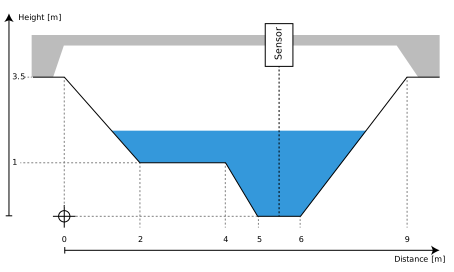
Figure 12 Cross-Sectional profile with height relative to bottom
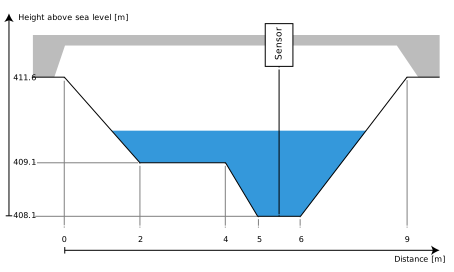
Figure 13 Cross-Sectional profile with absolute heights
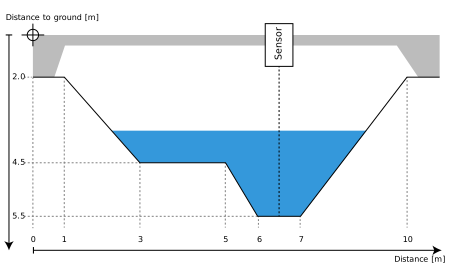
Figure 14 Cross-Sectional profile with heights relative to top
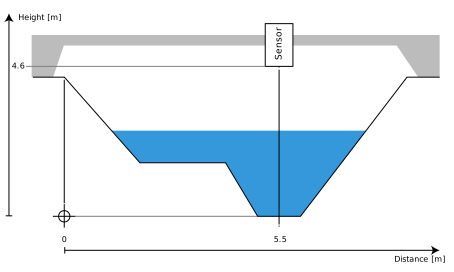
Figure 15 Cross-Sectional profile with RQ-30 position relative to bottom
- Build the discharge table
The survey of the measurement site is expressed in the form of a discharge table as shown in Table 1. This table is stored in the RQ-30 sensor and is the basis for the calculation of the discharge as described in Determination of water discharge.
The discharge table contains the cross-Sectional areas A(W) and k-factors k(W) of different water levels W. The areas A(W) are derived from the cross-Sectional profile, k-factors k(W) are determined according to Determination of water discharge.
The discharge table can contain up to 16 entries which are ordered from low to high water levels. A(W) and k(W) values are interpolated linearly to measured water levels.
The discharge table can be created with the software Q-Commander by Sommer Messtechnik. After entering the cross- Sectional profile, the channel/river roughness and the sensor position the discharge table is calculated automatically. This table can then be transferred to the RQ-30 sensor.
Status
Level (W)
K value
Area (A)
[m]
[ ]
[m^2]
01
on
0.4
64.0
4.7
02
on
0.6
68.7
9.5
03
on
0.8
72.1
14.4
04 … 14
...
…
…
…
15
on
4.9
79.5
141.8
16
on
6.7
80.7
202.4