
W-v relation
Generally, water level W and flow velocity v are related. If this relationship is assumed to be stable dis-charge rates can be deduced from water level measurements only. This functionality is implemented in the RQ-30 sensor as W-v learning, which means that the sensor continuously adjusts an internally stored W-v curve with each new measurement.
Usage
The W-v relation can be used to smooth velocity measurements and discharge rates. Generally, the water level fluctuates only slightly while the flow velocity can vary considerably depending on the flow conditions. By applying the learned W-v relation to the water level measurements velocity and dis-charge data can be smoothed.
Additionally, the W-v relation is used to interpolate flow velocities for water levels between the low level border WLL and the cease to flow level WCF as shown in Figure 20. Such conditions occur if stones impair the velocity measurement or if the sensor points to dry areas. For these low water levels the velocities can be interpolated from the W-v relation and thus provide valid velocity and discharge values.
ATTENTION If no stable W-v relation is present at the measurement site the learned W-v relation will provide unstable results as well.
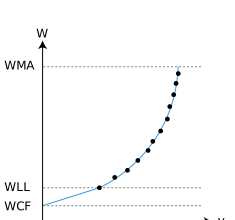
Figure 20 Interpolation of the flow velocity between WLL and WCF
Learning of the W-v relation
For the water level range between the maximum level WMA and the low level border WLL a table with 16 value pairs consisting of water levels and learned velocities is created. The learned velocities in the table are continuously adjusted with each new measurement. With time, the complete water level range is covered with learned velocities and a relatively stable relation between water level and velocity is generated, provided the measurement site allows this. Consequently, for each measured water level a learned velocity and a learned discharge can be assigned by linear interpolation.
ATTENTION The time needed to generate a complete W-v learning curve strongly depends on the fluctuations of the water level at the measurement site.
Water levels for the W-v relation
The range of water level, in which the W-v relation is learned, is defined by the special water levels WMA, WLL and WCF (see Water level measurement).
Activation
Usage of the W-v relation is activated as soon as one of the special water levels WMA, WLL or WCF is different from zero.
W-v priority
By default the W-v priority is set to no and the measured velocity and discharge are returned as main values. The learned velocity and discharge are returned as special values.
If the W-v priority is set to yes the learned velocity and discharge are returned as main values. The measured velocity and discharge are returned as special values.
W-v table reset
With this function the existing W-v table is deleted and the W-v learning starts anew. This is required if any of the special water levels WMA, WLL or WCF have changed or if the RQ-30 sensor is moved to an-other measurement site.